
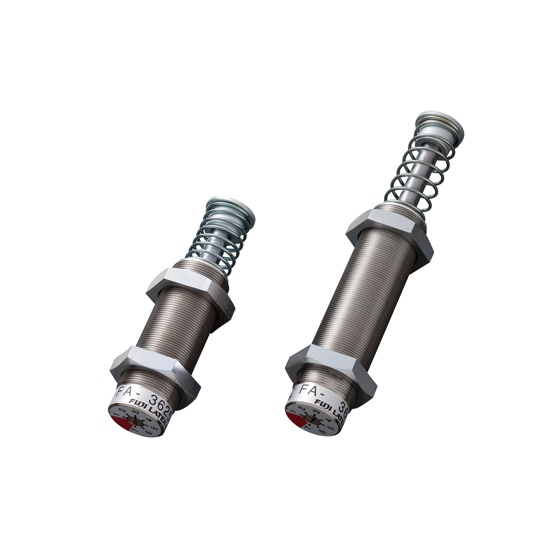
Shock Absorbers
Also known as: shock absorber, industrial shock absorber, deceleration, impact absorber, hydraulic shock absorber
With our dampers, you can add a sophisticated and smooth soft-closing movement to your lid closing design.
Takachiho America's dampers utilize the braking force that is generated by the silicone oils velocity resistance to provide the soft-closing feature.
We offer Rotary, Linear (shock absorbing), Disk, and other various types of dampers to suit your needs and will work with you to recommend the best dampers for your innovative designs.
Jump to model specifications →
Catalogs & Selection Guides
Not sure which model you need?
Models & Specifications
Shock Absorbers 10 models
| Model | Max absorption energy | Catalog |
|---|---|---|
| FA-1212 Series | 0.2–2.9 | |
| FA-0805/1005/1008/1210 Series | 0.39–2.45 J | |
| FA-3625/3650 Series | 200–400 J | |
| FA-4225/4250/4275 Series | 260–780 J | |
| FL Series(M12-M16) | 5.4–17.6 J | |
| FW Series(M12-M25) | 4.9–62.7 J | |
| FS Series | 3.5–15.6 J | |
| FV Series | 4.5–19.6 J | |
| FSB Series(M12,M14,M16) | 0.68–6 J | |
| FES Series(M6-M30) | 7–1800 J | PDF Absorber FES PDF Download Catalog PDF Read instructions PDF method PDF Download Model |
Dampers Line-up
For more detail, CAD data, customized spec requests, please contact us.
Basic Structure
This is a rotary damper that utilizes the braking force generated by the oil's viscosity resistance. The braking force generated by oil viscosity, clearance between the rotor and the main body, and the oil's contact area varies based on the structure shown above.
1-1) Temperature characteristics
The torque of a rotary damper varies according to the ambient temperature. This is because the viscosity of the oil inside the damper changes according to the temperature.
1-2) Speed characteristics
The braking torque of a rotary damper varies according to the cycle rate. In general, the torque increases when the cycle rate increases, and the torque decreases when the cycle rate decreases. The rated torque listed in the catalogue is the torque generated when the cycle rate is 20rpm.
This is a rotating-type damper that utilizes the oil pressure. The braking force generated by oil viscosity, clearance between the rotor and the main body, and the vane's pressure-receiving area varies based on the structure shown above.


Basic characteristics
Similar to the rotary damper, the torque varies according to the ambient temperature. Its basic structure is a dashpot structure (single orifice). The internal pressure of a damper increases as the rotation speed increases, which consequently increases the torque.


Cautions & Reference
Need CAD data, a custom spec, or a quote?
Email us with your model number and application — we reply within four business days.
Contact our engineersPrefer email, or need to attach a drawing? Write to [email protected].